Full-Stack Incident Response Platform
OnCallr
Client
Personal project
Timeline
2 Months
Role
Full-Stack Product Engineer
Year
2026
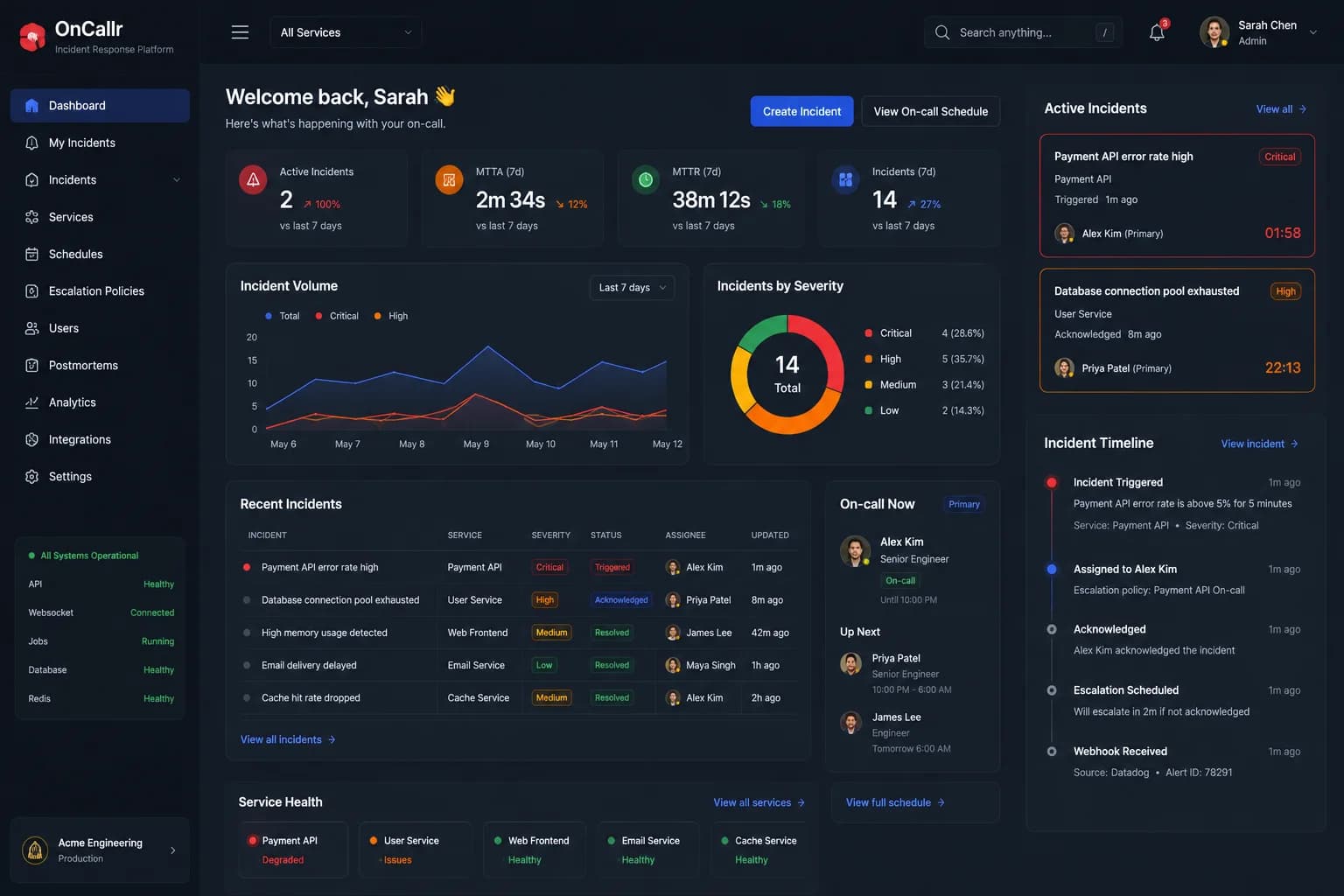
A schedule-aware on-call platform with webhook incidents, live delivery, automatic escalation, timelines, analytics, and AI-assisted postmortems.
Web / Next.js 16 / Fastify / Prisma / PostgreSQL / Redis / BullMQ / Socket.io / OpenAI
OnCallr is a full-stack incident response and on-call management platform designed for a single engineering team. It combines a Fastify API, Next.js dashboard, PostgreSQL data model, Redis-backed BullMQ jobs, and Socket.io delivery to coordinate incidents from initial webhook trigger through acknowledgement, resolution, postmortem, and analytics. The product supports admins and engineers through protected workflows while using escalation policies and on-call schedules to assign the correct responder automatically.
The Challenge
Incident response must remain dependable even when responders do not acknowledge immediately, browser sessions disconnect, or services restart. OnCallr needed durable escalation timers, schedule-aware assignment, secure service-specific webhook ingestion, real-time operator feedback, a complete event history, role-aware actions, and useful post-incident analysis without fragmenting the experience across separate tools.
The Impact
The platform centralizes on-call operations into one product, reduces manual responder coordination, preserves a traceable incident history, helps teams understand MTTA and MTTR, and turns resolved incidents into editable AI-assisted learning documents.
Incident Operations Dashboard
- 01
Accept incidents through a unique webhook URL assigned to each managed service.
- 02
Allow administrators to trigger incidents manually from the service dashboard.
- 03
Validate service webhook tokens before creating incident and event records.
- 04
Resolve the active on-call responder from schedule-backed escalation policies.
- 05
Assign severity and incident context at creation so responders receive actionable information.
- 06
Deliver immediate live notifications to the selected engineer through Socket.io.
Escalation & Scheduling
- Create escalation policies with ordered user or schedule-based steps.
- Build schedules from rotation members and generate future coverage shifts.
- Support shift overrides and swaps for real operational changes.
- Enqueue BullMQ escalation jobs when incidents are assigned.
- Reassign unacknowledged incidents when timeout windows expire.
- Keep escalation timers durable in Redis so they survive API process restarts.
Incident Operations
- Track triggered, acknowledged, and resolved incident states.
- Give engineers a focused My Incidents queue for assigned response work.
- Maintain a full incident event timeline from trigger through resolution.
- Support comments, acknowledgement, resolution, and administrator force-escalation actions.
- Push state changes into active dashboards and toast notifications in real time.
- Preserve operational context for later postmortem generation and analytics.
Postmortems & Analytics
- List resolved incidents that are ready for post-incident review.
- Generate structured postmortem drafts with the OpenAI Responses API.
- Allow teams to edit AI-generated content before saving the final record.
- Calculate MTTA, MTTR, incident totals, service volume, severity mix, and time-series trends.
- Measure busiest on-call coverage to make response load more visible.
- Filter analytics by date range and service for focused operational review.
Product Scope
Single-team incident response and on-call management
Architecture
Fastify API and Next.js dashboard monorepo
User Roles
Admin and engineer
Delivery Model
Real-time web application with durable background jobs
Project Role
Full-stack product engineering across frontend and backend foundations
Frontend
Next.js 16 and React 19 — Protected dashboard experiences for incidents, services, schedules, postmortems, and analytics
UI
Tailwind CSS 4 and shadcn/ui — Responsive application shell and reusable operational interfaces
Server State
TanStack Query — API data fetching, caching, invalidation, and dashboard synchronization
Charts
Recharts — MTTA, MTTR, service volume, severity, trend, and on-call load visualization
Backend
Fastify — Typed HTTP APIs, authentication, incident workflows, integrations, and business logic
ORM
Prisma — Relational schema, migrations, queries, and incident data access
Database
PostgreSQL — Persistent services, users, schedules, incidents, events, policies, and postmortems
Queue
BullMQ and Redis — Durable acknowledgement timeouts and automatic escalation processing
Real-Time
Socket.io — Live incident notifications, toasts, and dashboard updates
Authentication
Supabase Auth and Fastify JWT — Magic-link entry and secure in-app cookie sessions
AI
OpenAI Responses API — Generate editable structured postmortem drafts from incident context
Nodemailer — Fallback notification and operational email delivery
Webhook Incident Pipeline
- Each service owns a unique webhook token that can be rotated by an administrator.
- Incoming webhook payloads include incident title, description, and severity.
- The Fastify route validates the service token before accepting the trigger.
- The backend creates the incident and its initial timeline event in PostgreSQL.
- Schedule and escalation policy data determine the first responder assignment.
- Socket.io notifies the responder while BullMQ schedules the acknowledgement timeout.
Durable Escalation Architecture
- BullMQ stores delayed escalation work in Redis instead of relying on in-process timers.
- Queue workers evaluate whether the incident remains unacknowledged when a timeout expires.
- The escalation service advances through ordered policy steps and records reassignment events.
- User-based steps assign a specific engineer while schedule-based steps resolve current coverage dynamically.
- Durable jobs allow escalation behavior to continue correctly after backend restarts.
Schedules & Coverage
- Administrators create schedules and define ordered rotation membership.
- Future shifts are generated so responder coverage can be resolved ahead of time.
- Overrides provide temporary replacement coverage without destroying the base rotation.
- Shift swaps allow engineers to exchange assigned coverage windows.
- Coverage data feeds both incident assignment and on-call workload analytics.
Authentication & Permissions
- Supabase magic links provide the initial frontend authentication experience.
- The application exchanges authenticated identity for a Fastify cookie-based JWT session.
- Protected dashboard routes prevent unauthenticated access to operational data.
- Engineer permissions focus on assigned incidents and response actions.
- Administrator permissions add service, schedule, policy, analytics, and force-escalation management.
AI-Assisted Postmortems
- Resolved incidents provide the source timeline and operational context for draft generation.
- The backend calls the OpenAI Responses API to produce structured postmortem content.
- Generated drafts remain editable so engineers can correct context and add human judgement.
- Final postmortem records are saved against the originating incident.
- The workflow accelerates documentation without treating AI output as an unreviewed final report.
Analytics & Operational Learning
- MTTA measures the delay between incident trigger and responder acknowledgement.
- MTTR measures the time required to move an incident from trigger to resolution.
- Status, service, severity, and time-based summaries expose incident patterns.
- On-call load analysis shows which responders or coverage windows carry the most activity.
- Date-range and service filters let administrators isolate meaningful operational slices.
Monorepo & Local Development
- api contains the Fastify server, Prisma schema, BullMQ jobs, and Socket.io delivery layer.
- web contains the Next.js dashboard and frontend integrations.
- docs contains deployment and demo guidance while features.md records product behavior.
- PostgreSQL and Redis provide the required local persistence and queue infrastructure.
- Prisma migrations and seed scripts create demo services, schedules, admins, and engineers.
- Separate frontend and backend development servers run on ports 3000 and 5000.
Quality & Deployment
- Frontend and backend packages each provide lint and production build checks.
- The Next.js dashboard is suited for deployment on Vercel.
- The Fastify API can run on Railway, Render, or Fly.io.
- PostgreSQL can use Supabase or Railway while Redis can use Upstash or Railway Redis.
- WEB_ORIGIN and public API or Socket URLs connect deployed frontend and backend services safely.
- SMTP and OpenAI credentials enable email fallback and AI postmortem generation outside local development.