School Management & Parent Supervision Platform
UniVerse School Management Platform
Client
Personal project
Timeline
2 Months
Role
Full-Stack Developer and System Designer
Year
2026
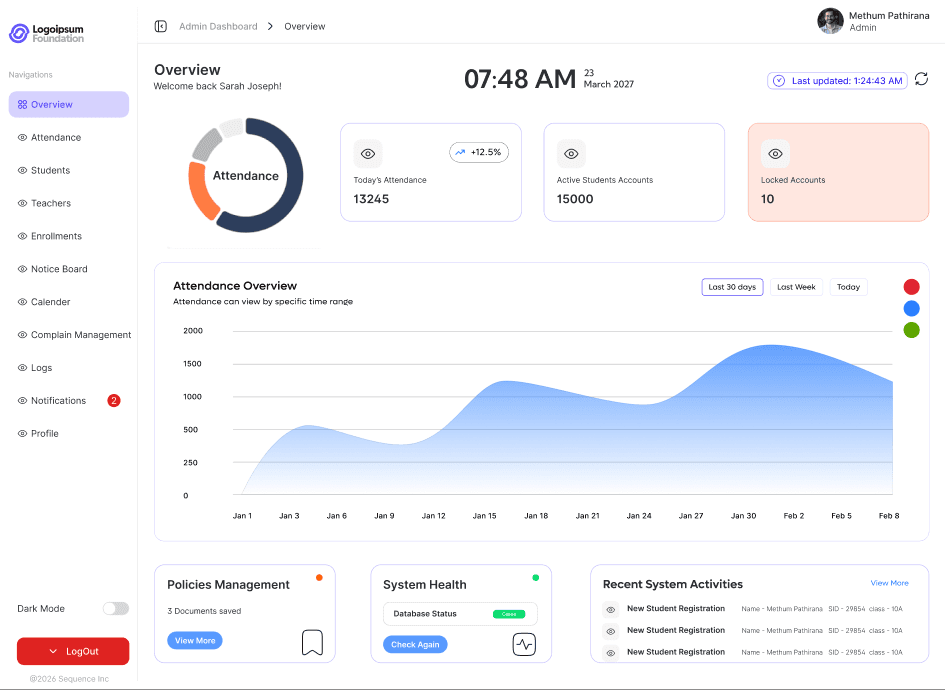
A full-stack school management platform connecting admins, teachers, security staff, and parents through a unified backend, web dashboard, and mobile app.
Web / Mobile / Fastify / Next.js / Flutter / TypeScript / PostgreSQL / Docker / Firebase / Gemini
UniVerse is a large-scale school management system built as a final year project to unify school operations across multiple user groups. The platform combines a Fastify backend, a Next.js web dashboard, and a Flutter mobile app to support admins, teachers, security staff, and parents in one connected ecosystem. It includes attendance management, QR-based gate tracking, results publishing, messaging, announcements, complaints handling, lost and found reporting, push notifications, and an AI-powered RAG chatbot for policy-aware assistance.
The Challenge
School operations are often split across disconnected tools, manual records, and separate communication channels. UniVerse needed to create one secure role-aware ecosystem that could manage academic workflows, gate activity, parent visibility, communication, support requests, and policy-aware assistance across web and mobile experiences.
The Impact
The resulting multi-platform system centralizes operational and academic workflows, gives parents timely visibility into student activity, supports faster communication between school stakeholders, and establishes a deployment-ready technical foundation for future school-wide expansion.
Admin Dashboard
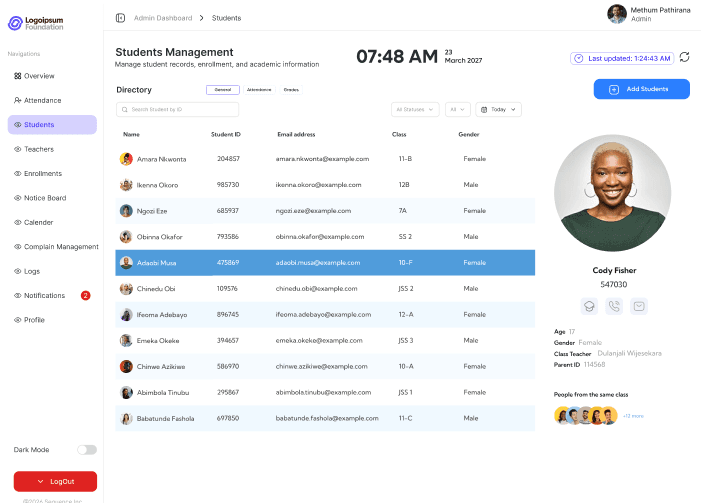
Teachers List
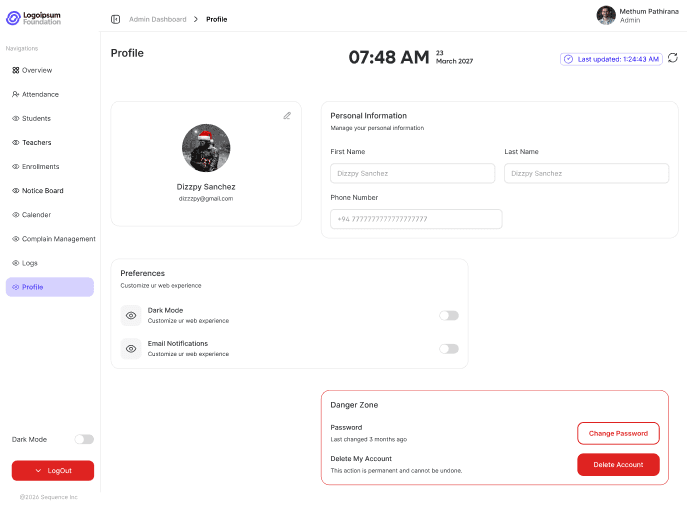
User Profile
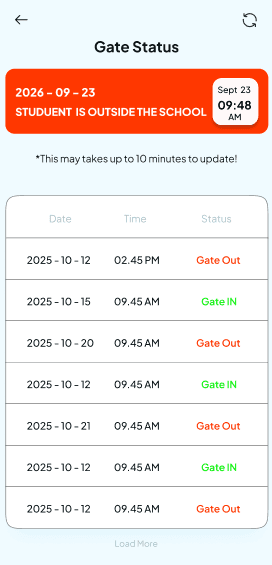
Mobile Attendance
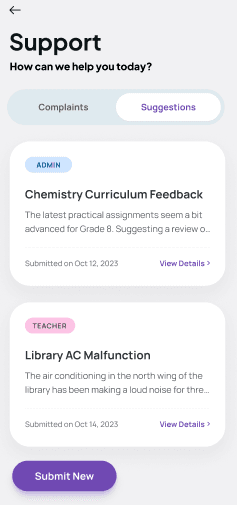
Mobile Support
- 01
Designed and implemented the full system structure across backend, web, and mobile application layers.
- 02
Built role-based access flows for admins, teachers, security staff, parents, and pending users.
- 03
Developed core modules including attendance, gate logs, announcements, messaging, complaints, and results management.
- 04
Integrated the Fastify API with the Next.js dashboard, Flutter parent app, and Firebase notification workflows.
- 05
Set up the monorepo structure, Docker-based development flow, environment configuration, and supporting tooling.
- 06
Implemented AI-assisted school support through RAG-based backend workflows and retrieval logic.
- 07
Maintained project quality through testing support, documentation, and structured development practices.
Platform Roles & Access
- Admin Role: Manage overall school operations, users, notices, complaints, attendance, and reporting flows.
- Teacher Role: Handle classes, attendance, results, messages, and class-scoped notices.
- Security Role: Manage gate logs, QR scanning, and student entry-exit monitoring.
- Parent Access: Use the mobile app to track attendance, notifications, results, notices, support, and student status.
- Pending User Flow: Support controlled onboarding and approval before users receive platform permissions.
Core Academic & Gate Features
- QR-based gate IN/OUT scanning with entry-exit monitoring and parent alerts.
- Automatic checkout logic to support accurate daily gate records.
- Daily attendance sessions and batch attendance submission workflows.
- Calendar-based attendance views for reviewing student history.
- Publishable term results with structured access for teachers and parents.
Communication & Support
- Messaging threads connecting relevant school users through structured conversations.
- School-wide and class-scoped announcements with targeted visibility.
- AI-assisted draft suggestions for clearer and faster communication.
- Complaints triage and handling workflows for structured issue resolution.
- Lost and found reporting for submitting, tracking, and resolving item reports.
- Push notifications and email-based approval flows for time-sensitive updates.
Project Type
Final year software engineering project
Role
Full-Stack Developer and System Designer
Platforms
Fastify backend, Next.js web dashboard, and Flutter mobile app
Primary Users
Admins, teachers, security staff, parents, and pending users
Delivery Model
Multi-application monorepo with Docker and CI support
Backend
Fastify — High-performance API services, role-aware business logic, and platform integrations
Web
Next.js and React — Administrative, teacher, and security dashboard workflows
Mobile
Flutter — Structured parent-facing access to attendance, results, notices, support, and student status
Language
TypeScript — Type-safe backend and web application development
ORM
Prisma — Schema modelling, migrations, and structured database access
Database
PostgreSQL — Relational storage for users, school records, attendance, results, and operational data
Cache
Redis — Fast temporary data access and supporting backend workflows
Notifications
Firebase — Push notification delivery and parent alert workflows
AI
Gemini and RAG — Policy-aware assistance, retrieval workflows, and AI-assisted school support
Infrastructure
Docker — Consistent local development and production-oriented service orchestration
Delivery
CI workflows and Vercel — Automated quality checks and deployment-ready frontend configuration
Backend & AI Services
- Fastify provides the central API layer for authentication, permissions, academic modules, gate operations, messaging, and support workflows.
- Prisma manages relational models and database access across PostgreSQL-backed school records.
- Redis supports fast temporary state and performance-sensitive backend workflows.
- Firebase integration delivers push notifications for attendance, gate activity, notices, and other parent-facing alerts.
- Gemini-powered RAG services retrieve relevant school policy context before generating assistance, helping responses remain grounded in approved information.
Web Dashboard
- Next.js, React, TypeScript, and Tailwind CSS power role-specific admin, teacher, and security workflows.
- Dashboard access and available actions change according to authenticated role and assigned permissions.
- Web modules cover user administration, notices, complaints, attendance, results, messaging, and operational reporting.
- Security-facing screens support QR scanning and gate log visibility for entry-exit supervision.
Parent Mobile Application
- Flutter provides the parent-facing mobile experience through structured feature modules.
- Parents can review attendance, term results, notices, notifications, support information, and current student status.
- Gate and attendance events connect to alert workflows so parents receive timely updates.
- Mobile features consume the same Fastify API used by the web platform, keeping data and permissions consistent across applications.
Architecture & Monorepo
- A shared npm workspace organizes backend, frontend, and supporting packages within one coordinated repository.
- The Flutter application is maintained alongside the web and API layers as part of the complete platform delivery.
- Environment configuration separates local development requirements from deployment-ready settings.
- Shared tooling and structured scripts reduce setup friction and keep development practices consistent across applications.
Docker & Development Workflow
- The Docker development stack supports hot reload across backend, frontend, and Redis services.
- A separate production compose setup prepares services for production-oriented execution.
- Containerized dependencies make onboarding more predictable and reduce environment differences between contributors.
- Database, cache, API, and web services can be coordinated through repeatable development commands.
Quality & Delivery
- Husky and commitlint support consistent commit practices and local quality safeguards.
- CI workflows provide automated validation for the multi-application codebase.
- Testing support, technical documentation, and structured development practices are included within the final year project scope.
- Vercel configuration prepares the Next.js dashboard for web deployment while production compose files support service delivery.